Building a Scalable, AI-Ready UX Practice
Creating the process, governance, and collaboration model needed to scale UX and prepare for AI-assisted design
During my seven years at Bethesda.net, my role evolved from Senior Product Designer to UX Manager. I led the development of a scalable UX operating model and later researched how AI-assisted prototyping could extend that practice.
The UX process was implemented. The AI initiative remained a proposal because the available tools did not fully meet our enterprise requirements, and the team was affected by layoffs before a pilot could begin.
At a Glance
Role: Senior Product Designer → UX Manager
Partners: Product, Engineering, Research, QA, Accessibility, and leadership
Focus: UX operations, governance, accessibility, documentation, and AI-tool strategy
Status: UX process implemented; AI extension researched and proposed
The Challenge
As the product ecosystem and workload grew, the team needed a shared model that could:
Bring UX into product planning earlier
Clarify expectations and ownership
Improve collaboration across disciplines
Make design work easier to estimate and track
Standardize documentation and handoff
Scale based on project complexity
Support responsible experimentation with AI
The UX Operating Model
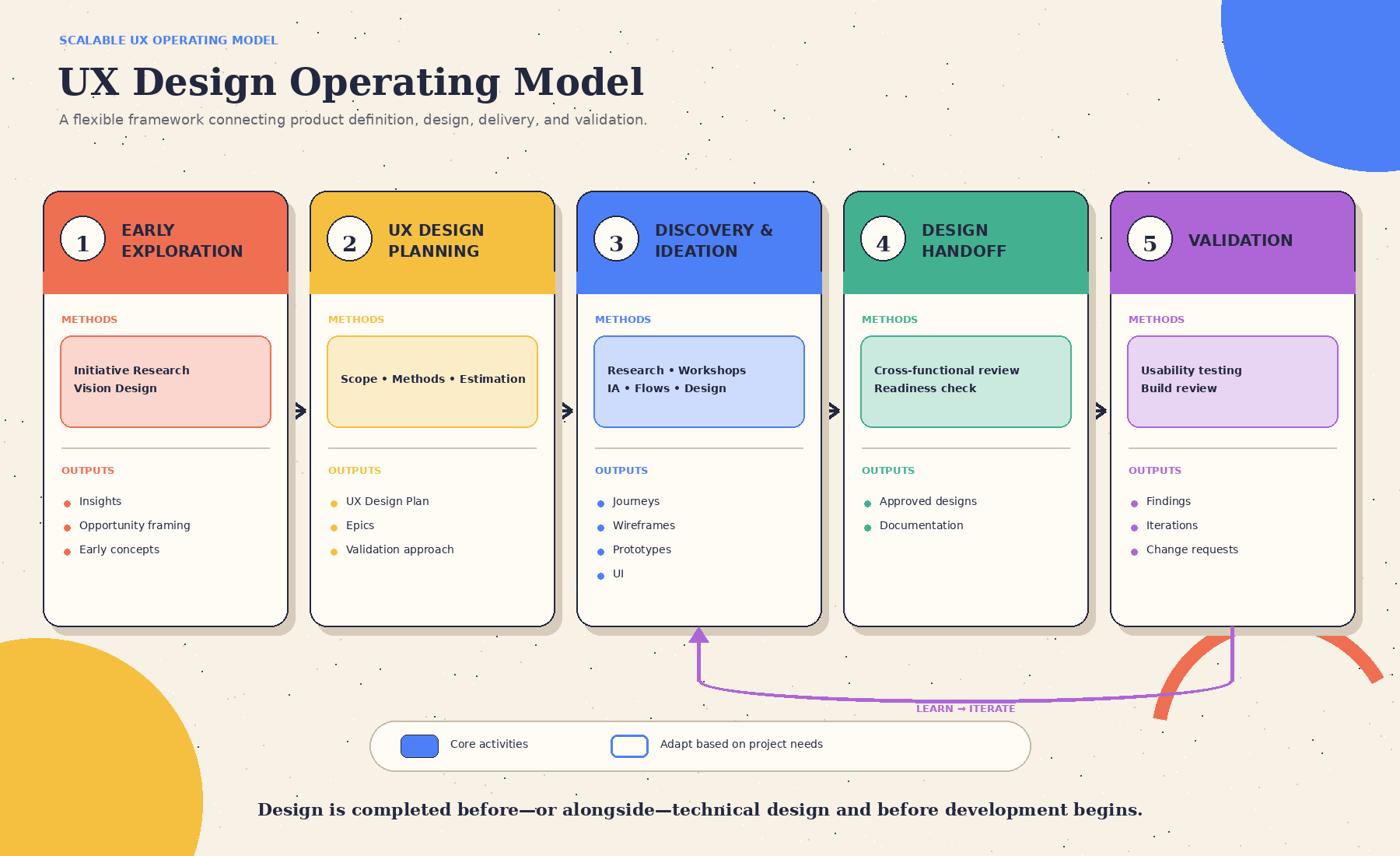
I established a flexible process organized around three stages:
Early Exploration
UX Design Planning
Discovery & Ideation
Design Handoff
Validation
Each stage included core activities and optional methods. This created consistency without forcing every initiative through the same amount of design work.
Connecting UX to Development
The UX process was integrated into the existing product and development lifecycle.
Key additions included:
Initiative Research to define the opportunity, audience, and user value
Vision Design to make early ideas tangible
UX Design Plans to document scope, deliverables, dependencies, validation needs, and estimates
Formal Design Handoffs with Product, Design, and Engineering
Change governance for issues identified during validation or development
Design also owned its Jira epics, stories, and tasks. Documentation followed the same hierarchy:
Initiative → Epic → Supporting documentation
This created a clearer connection between planning, design decisions, and implementation.
Exploring an AI-Assisted Extension
Once the UX foundation was established, I explored whether AI could help teams move from business requirements to an initial prototype faster.
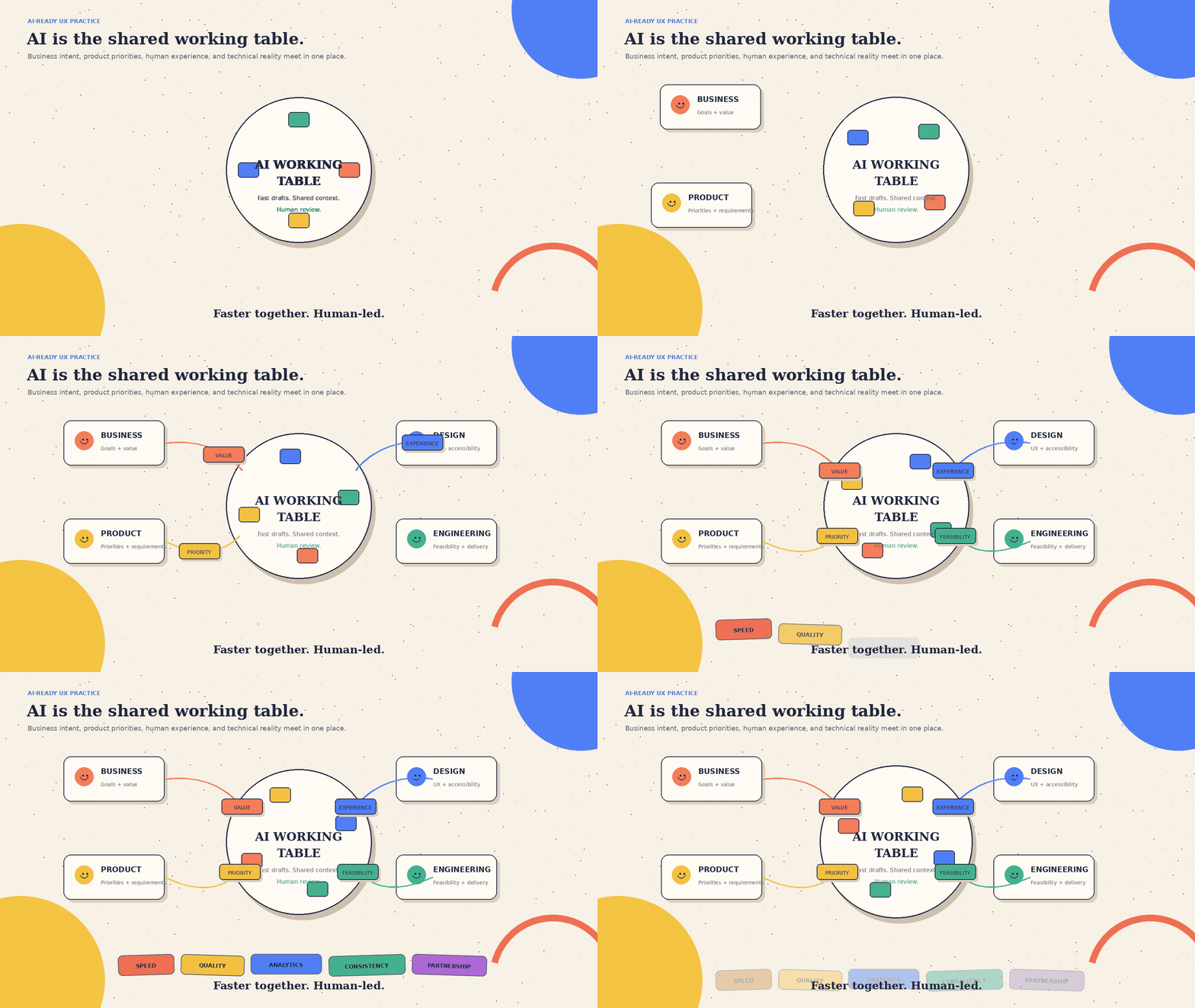
The goal was not to replace designers. It was to create a shared working layer for Business, Product, Design, and Engineering.
Evaluating the Tools
I compared leading AI prototyping tools using enterprise-focused criteria:
Security and data governance
Administrative controls
Licensing and minimum-seat requirements
Design-system integration
Accessibility support
Prototype quality and editability
Collaboration and development handoff
Scalability and cost
The research revealed a gap between accessible individual tools and enterprise-ready platforms.
Some tools lacked the required governance and security controls. Others required enterprise commitments of approximately 20 seats or more, making a small cross-functional pilot difficult to justify.
No evaluated tool fully satisfied our security, workflow, accessibility, and design-quality requirements.
The Proposed Collaboration Model
I developed a plan for a shared AI-assisted workflow:
Business defined the opportunity, value, goals, and constraints.
Product Managers translated requirements into an initial AI-generated prototype.
Designers refined the experience using research, the style guide, UX principles, and accessibility standards.
Developers evaluated technical feasibility, integration needs, and implementation risks.
AI could accelerate the first draft, but people would retain responsibility for product, design, and technical decisions.
AI accelerates alignment. People own the decisions.
Governance and Pilot Plan
Before adoption, the team would need to define:
What information could be shared with the tool
How generated output would be reviewed
Who held design and technical approval
How accessibility and style-guide compliance would be maintained
Whether generated code could be used in production
The next step was intended to be a limited cross-functional pilot measuring speed, prototype quality, alignment, accessibility, and revision effort.
The pilot did not move forward. The tools were still evolving, enterprise adoption remained difficult, and the team was affected by layoffs before the evaluation could be completed.
I therefore present this work as AI strategy, research, and an operating-model proposal—not as a deployed AI transformation.
Impact
The implemented operating model:
Brought UX into initiatives earlier
Improved planning and estimation
Clarified ownership and expectations
Standardized documentation and handoff
Strengthened accessibility and design governance
The proposed AI extension:
Identified opportunities for AI-assisted collaboration
Exposed enterprise security and licensing barriers
Defined responsibilities across Business, Product, Design, and Engineering
Established a responsible foundation for a future pilot
This work reflects my approach to leadership: build the operational foundation first, evaluate emerging technology critically, and keep people accountable for the final decisions.